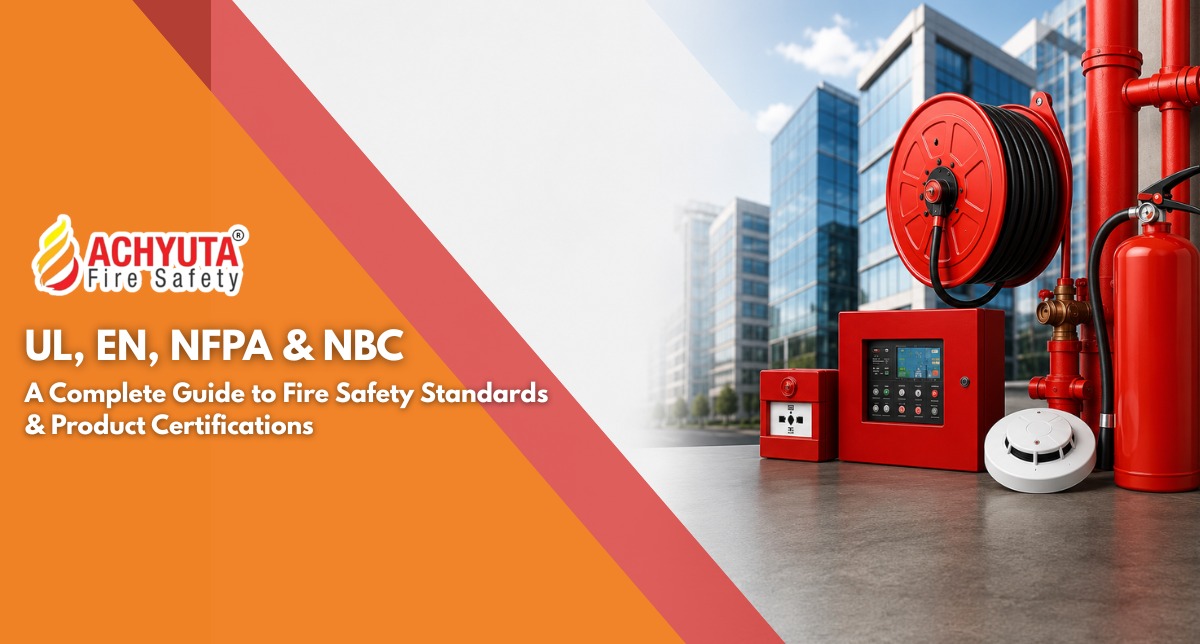
UL, EN, NFPA & NBC: What's the Difference in Fire Safety Product Certifications?
Overview
If you've ever shopped for fire safety equipment or managed a commercial building project, you've likely encountered an alphabet soup of certifications: UL, EN, NFPA and NBC. To the uninitiated, they might look like bureaucratic jargon. Still, in the realm of fire safety, these acronyms represent the thin line between a minor contained incident and a catastrophic loss of life and property.
At Achyuta Fire Safety, we believe that understanding these certifications isn't just for engineers and compliance officers it's essential for anyone responsible for building safety.
But what exactly do these certifications mean, and how do they differ? Let's break down the four heavyweights of fire safety standards.
Product Safety Standards
UL (Underwriters Laboratories): The Product Safety Benchmark
When you see a "UL Listed" mark on a fire extinguisher, smoke detector or fire pump, it means the product itself has been rigorously tested by Underwriters Laboratories, a global safety certification company headquartered in the US.
- What it is: An independent, third party product safety testing and certification organization.
- What it covers: The physical product. UL tests fire safety products to ensure they perform exactly as intended under specific fire conditions. Will that fire door hold back flames for two hours? Will that sprinkler head activate at the right temperature? UL tests these exact metrics.
- The Takeaway: If a product is UL certified, you can trust that the hardware will work when you need it most.
EN (European Norm): The European Standard
EN standards are the product benchmarks recognized across the European Union. Developed by the European Committee for Standardization (CEN), these standards ensure uniformity in product performance across European member states.
- What it is: A set of standards designed to facilitate trade and ensure safety across Europe.
- What it covers: Similar to UL, EN standards govern the performance and testing of fire safety products. You will often see the "CE mark" on products, which indicates conformity with EN standards. For example, EN 3 covers portable fire extinguishers dictating how they must be built, tested and colour coded.
- The Takeaway: EN is the European equivalent of UL. It guarantees that a product meets the strict manufacturing and performance criteria set by European safety authorities.
Codes & Guidelines
NFPA (National Fire Protection Association): The Code of Practice
While UL and EN focus on the product, NFPA focuses on the practice. The NFPA is an international nonprofit organization that creates and maintains private, copyrighted standards and codes for usage and adoption by local governments.
- What it is: A global organization that writes codes and standards for fire safety.
- What it covers: How fire safety systems are designed, installed, inspected and maintained. The most famous is NFPA 13 (Standard for the Installation of Sprinkler Systems) or NFPA 72 (National Fire Alarm and Signalling Code).
- The Takeaway: NFPA doesn't test the sprinkler head (that's UL's job) instead, NFPA dictates exactly how far apart those sprinkler heads must be placed, how much water pressure the system needs and how often they must be inspected.
NBC (National Building Code): The Structural Mandate
In many countries, particularly in India the National Building Code (NBC) serves as the overarching legal framework for building construction and safety.
- What it is: A comprehensive set of building guidelines published by the Bureau of Indian Standards (BIS) that serves as a model code for adoption by all agencies involved in building construction.
- What it covers: The entire building. Part 4 of the NBC is dedicated entirely to Fire and Life Safety. It dictates the architectural and structural requirements of a building, such as the width of staircases the number of emergency exits required based on occupancy the mandatory inclusion of fire compartments and the overall fire protection systems required for different types of buildings (e.g., hospitals vs. office towers).
- The Takeaway: The NBC is the law of the land for builders and architects. It ensures the building is fundamentally designed to allow people to evacuate safely and allows firefighters to do their jobs.
Interaction & Compliance
Putting It All Together: How They Interact
To understand how these four work in harmony, imagine you are building a new high rise commercial office. Here is how they interact:
- NBC: Dictates that because it's a high rise commercial building, it must have an automatic sprinkler system, a fire alarm system and two fire protected staircases.
- NFPA: Provides the rulebook for the contractor on exactly how to design, install and test that sprinkler and alarm system.
- UL / EN: Ensures that the specific sprinkler heads, fire pumps and smoke detectors purchased for the building have been physically tested and proven to work under extreme heat and pressure.
Why Achyuta Fire Safety Adheres to All Standards
At Achyuta Fire Safety, we don't believe in cutting corners. Fire safety is a complex ecosystem where a flawlessly designed system (NFPA/NBC) is useless if the components fail (UL/EN) and the best components in the world are useless if they are installed incorrectly.
That is why our team of experts ensures that:
- Every product we supply and install carries the necessary UL/EN certifications.
- Our system designs are strictly in compliance with NFPA codes.
- Our overall project execution aligns flawlessly with local NBC regulations.
When you partner with Achyuta Fire Safety, you aren't just buying equipment you are investing in a comprehensively certified, legally compliant and human centric safety net.
Frequently Asked Questions
1. What is UL certification in fire safety?
Ans: UL (Underwriters Laboratories) certification indicates that a fire safety product has been independently tested and meets recognized safety and performance standards. UL Listed products are widely accepted in North America and many international markets.
2. What does EN certification mean?
Ans: EN (European Norm) certification means a product complies with European safety and performance standards. Fire alarms, extinguishers, sprinklers and emergency lighting products sold in Europe are commonly tested against EN standards.
3. Is NFPA a product certification?
Ans: No. NFPA (National Fire Protection Association) does not certify or list fire safety products. It develops fire safety codes and standards that guide the design, installation, inspection and maintenance of fire protection systems.
4. Is NBC a product certification in India?
Ans: No. The National Building Code (NBC) of India is a building code that specifies fire and life safety requirements for buildings. It is not a product certification or testing authority.
5. What is the difference between UL, EN, NFPA, and NBC?
Ans:
- UL - Product testing and certification.
- EN - European product standards.
- NFPA - Fire safety codes and standards.
- NBC - India's building code for fire and life safety.
Each serves a different purpose in ensuring fire safety.
6. Which certification is accepted in India?
Ans: India commonly follows the National Building Code (NBC), relevant BIS standards and often references NFPA standards for fire protection system design. Many projects also specify UL Listed or EN Certified products depending on project requirements and client specifications.
7. Are UL Listed products better than EN Certified products?
Ans: Not necessarily. Both are respected internationally. The right choice depends on your project's regulatory requirements, location and specifications rather than one certification being universally superior.
8. Why are certified fire safety products important?
Ans: Certified products provide confidence that they have been tested for safety, reliability and performance. They also help ensure compliance with project specifications and applicable fire safety regulations.
9. Can a fire safety product have both UL and EN certifications?
Ans: Yes. Many global manufacturers obtain multiple certifications to comply with the requirements of different countries and markets.
10. How do I choose the right fire safety products for my building?
Ans: Select products that comply with your local regulations, project specifications and applicable standards. Consulting experienced fire safety professionals ensures your system is compliant, reliable and suitable for your building's needs.
Professional Fire Safety Services
Our Fire Safety Certifications & Standards in Odisha
Achyuta Fire Safety is a premier safety consultant specializing in international and national safety compliance:
- Certified Fire Safety certifications in odisha.
- Standard-compliant Fire safety standards in odisha.
- Expert NBC fire safety guidelines.
- Certified Fire protection systems Odisha.
- Supply of Certified fire safety products Odisha.
- Compliance under Fire safety codes and standards.
- Tailored Fire safety solutions Odisha.
- Authorized Fire safety product certifications.
- Supply of each Certified fire safety product.
- Guaranteed Fire safety compliance.
- Authorized UL Certifications & EN certifications.
- Professional Fire protection certifications.
As the best fire safety certified company in odisha and a premier Fire safety consultant Odisha, we ensure full compliance with NFPA standards and NBC fire safety codes. Contact us to safeguard your project today.